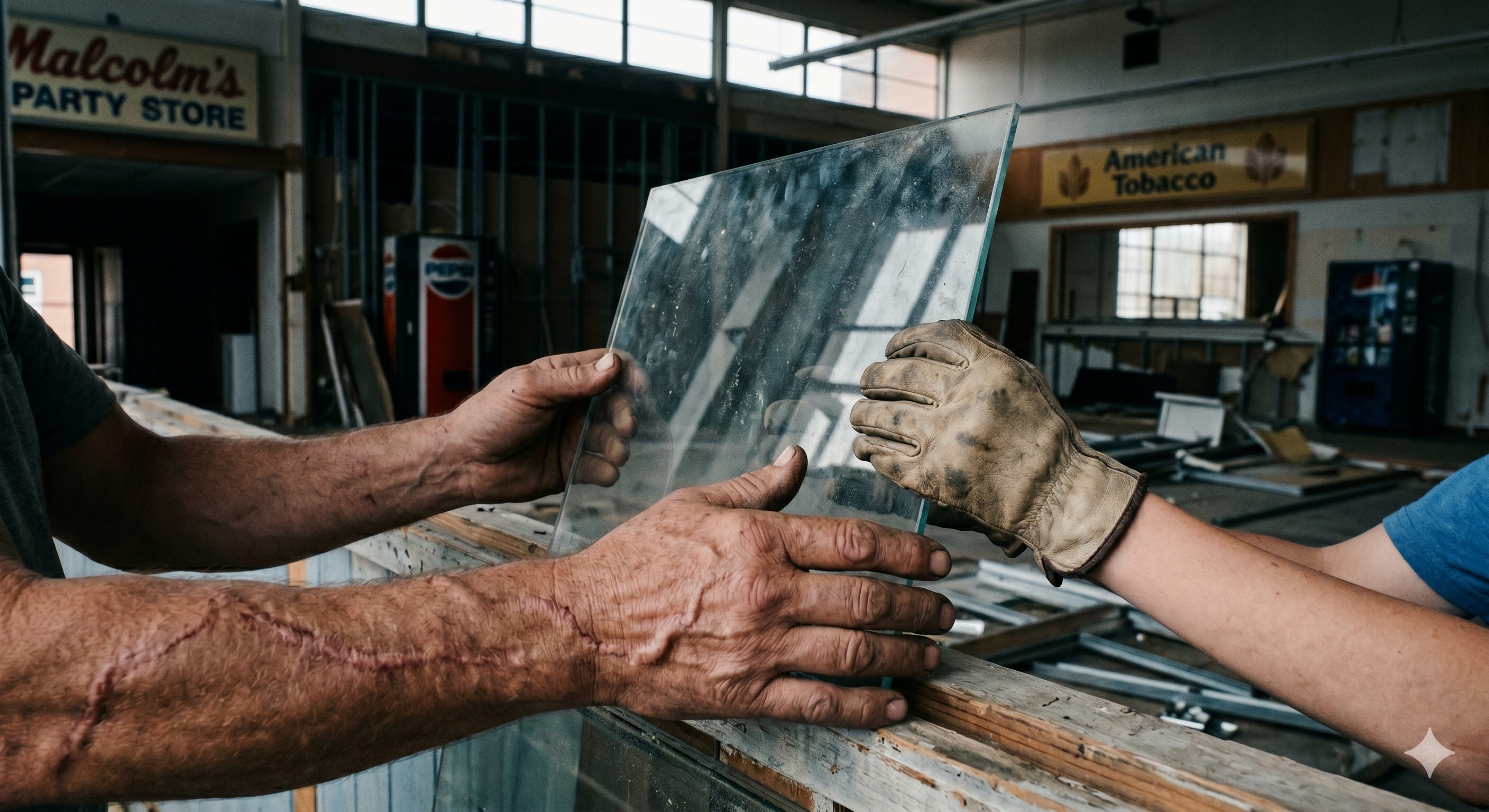
My dad managed a department store while I was growing up. The summer I turned fourteen, he oversaw a full remodel that stripped the store of its fixtures and started it over from scratch. A local party store owner named Malcolm was hired to do the removal work, and as part of the deal, I ended up on the crew doing the labor.
It was strictly off the books. The kind of arrangement that came naturally to my dad.
Every morning at 7:30, I was dropped off at Malcolm’s party store. I waited on a wooden stool, wedged between an ice cooler chained shut and a Pepsi vending machine that emitted a constant electric hum. Malcolm drove a dented blue truck with an extended bed and an eight-ball shifter. He would race into the parking lot, squeal to a stop, and shout, “Well, c’mon,” as if I were the reason he was running late.
Our first stop was to pick up a crew member named Dennis, which was easier said than done because he was never in the same place twice. We would slow-roll through convenience store parking lots, neighborhoods with rows of identical shotgun houses, or down dead-end alleyways around the American Tobacco warehouses.
“What happens if we don’t find him?” I asked one day.
“He won’t be drinking tonight,” Malcolm said, with a snort.
Most days we found him outside the EZ-Quick Mini Mart with a paper bag of pickled eggs and a jumbo-sized Mountain Dew. He would open the cab of the truck and stutter, “Slide over, boss,” before I moved to the middle and straddled the eight-ball.
The job was easy enough, though sometimes backbreaking. We would show up at the store and my dad would point us toward an empty section where the merchandise had already been cleared out. Dennis and I broke the fixtures down by hand, piece by piece, until they were small enough to load into Malcolm’s truck. I worked fast because I thought that was what was expected of me. Dennis worked like he was perpetually in first gear, idling through the day.
Moving glass was trickier, because a chipped corner or a cracked piece cut into Malcolm’s profit when he tried to resell it. Whenever we had to move glass, Dennis would come to life and instruct me in the proper way to handle it.
“Grab her like this,” he would say, his calloused hands miming holding the edges of the glass flat, “and when I count to three, we swivel it in unison.”
I adjusted my gloves and nodded.
“And look here,” he said, pausing. “Slow down. If you drop her, let her go. Don’t try to catch her or she’ll cut you up.”
He held his left hand out to show a jagged scar that started in his palm, ran up his forearm, and coiled around the back of his arm just before the elbow.
“Now come on and grab hold like you mean it,” he said. I took the edge of the panel as he showed me, and swiveled on his count.
“Yeah! Yeah, Billy, that’s it. You got it,” he said louder than necessary, making a show for my dad and Malcolm, who had come over to watch.
We shuffled through the main aisle of the store and out the door into the parking lot. We wrapped the glass in thick blankets and stacked it in the back of the truck. I started to walk back but Dennis stopped me.
“Hold up. Next time I ain’t going to explain it. Uh Malcolm ain’t paying me enough for all that. You grab hold like I showed you, handle her with care, and you’ll be alright.”
Since I started writing this Substack a year ago, I’ve thought about Dennis. Writing in public feels a lot like moving glass. Some pieces I’ve grabbed just right and carried with ease. Others slipped through my fingers. What I’ve learned is that memories are fragile, as are the people who inhabit them. The trick isn’t whether you move them or not. The trick is knowing when to slow down, and when to let go.
This One’s Called… Handle With Care